China's Moment of Clarity in AI: Even with Only 20% Chance of Success, We Must Lay Solid Foundations
Published: 2026-01-14 10:30:00
Category: AI
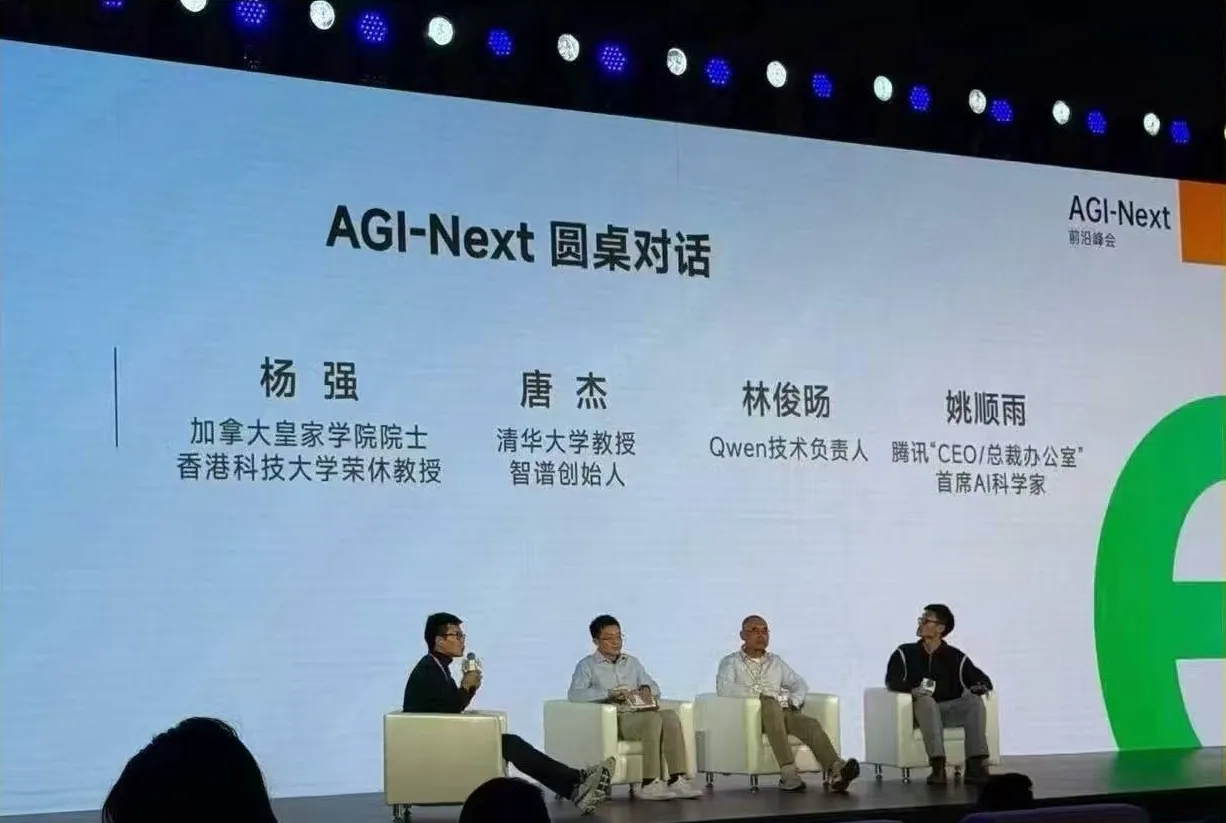
Summary: At the AGI-Next conference in Beijing early 2026, Yang Qiang, Tang Jie, Lin Junyang, and Yao Shunyu (remotely), four "practitioners" in the AI field, sat together. They didn't talk about grand AGI sci-fi stories and didn't avoid the "awkward truths" in the industry. They acted like hands blowing away bubbles, revealing the roughest and most authentic base of Chinese AI.
Today I'd like to share a particularly "heartfelt" closed-door roundtable discussion — at the AGI-Next conference in Beijing early 2026, Yang Qiang, Tang Jie, Lin Junyang, and Yao Shunyu (remotely), four "practitioners" in the AI field, came together. They didn't speak of grand AGI sci-fi stories, nor did they shy away from the "awkward truths" in the industry. They acted like hands blowing away bubbles, revealing the roughest and most authentic base of Chinese AI. After reading, I just felt: Clarity is the gentlest armor for technologists.
🔴 One. Harsh Truth: China's Biggest AI Problem is "Poverty"
Ali's Lin Junyang explained the Sino-US gap with a metaphor—it's a game between "rich and poor".
The so-called "rich" refers to OpenAI holding computing power 1-2 orders of magnitude larger than ours; they can "waste" computing power exploring uncharted territories;
while we are the "poor": most Chinese companies' computing power is barely enough to handle daily business, leaving no surplus capacity to bet on "uncertain futures".
But being "poor" has also forced us to develop expertise: extreme joint optimization of algorithms and infrastructure. This "change-thinking-out-of-poverty" engineering capability is our "oxygen tube" to stand steady under computing power blockades.
🔑 Two. Industry Turning Point: To C Sells EQ, To B Delivers Real Value
Tencent's Yao Shunyu, who returned from OpenAI, shared his truth about To C for the first time publicly: over the past year, models have been desperately competing for "scores," but users can't really distinguish between a score of 92 and 98—no matter how powerful ChatGPT is at solving math problems, its significance for ordinary people is actually quite limited.
The core of To C has never been about competing intellectually, but about competing to "understand you": whether the model knows you're working overtime today, whether it can pick up on your low mood, matters more than "calculating faster".
Real value lies in To B and Coding: enterprises are willing to pay $200 for a model that does 10 things right 9 times, but will never spend $200 on cheaper goods that get 5 things right—this is implementable productivity, the warmth of real money.
⚠️ Three. Agent Startup Warning: Model as Product, Shell Applications Have No Future
If you're currently doing Agent startups or following trends to build "shell" applications, please pay close attention to this section:
The conclusion at the roundtable was direct: Model as product, shell applications have no future.
Lin Junyang pointed out the key: the "long-tail problems" encountered by Agents cannot be solved by changing Prompts or adjusting application code; one must retrain at the model level. Without your own model capabilities, no amount of fancy "shell" can build moats.
The warmth of technology has never come from "taking shortcuts," but from solid steps forward.
💔 Four. The Most Piercing 20%: Our Generation Might Be "Pioneers"
The host asked a piercing question: What is the probability that the world's leading AI company will be Chinese in 3-5 years?
Lin Junyang's answer was: 20%.
This number doesn't sound good, yet it's realistic: we lack computing power, talent density, and especially a research culture that dares to "bet on uncertainty"—we're accustomed to "scoring to achieve results," whereas OpenAI's success was precisely gambling on a path "without assurance" in 2022.
But Professor Yang Qiang from HKUST said something that broke all technologists' hearts:
"Our generation of AI practitioners might not live to see victory… But by laying the foundation well, the next generation might be the one to achieve victory."
✍️ Ending Thoughts: Even with Only 20%, We Must Proceed Steadfastly
Acknowledging "poverty," acknowledging gaps, acknowledging low odds of success—is not selling anxiety—
it's because we know: the warmth of technology has never come from shouting slogans of "far ahead," but from seeing the cards clearly, and still focusing on doing engineering implementations meticulously.
The battle for AI is hard to fight, the chances of winning aren't high, but as long as we're still "at the table," don't easily step down.
Stay clear-headed, steadily pave the way, the road is long, let's walk slowly.
Follow "Technology Warms Life"
Focusing on technological frontiers and industrial implementation, viewing technological changes with rational perspectives, not chasing fads, only doing practical "pioneering" work.